A yacht charter fee includes exclusive use of the vessel, marine insurance, safety equipment, the tender and, on crewed charters, the professional crew. Fuel, food, drinks, mooring, taxes and gratuity are billed separately on most motor yachts, usually through an Advance Provisioning Allowance of 30% to 40% of the base rate.
The confusion comes from one thing: not all charters are priced the same way. Some are all-inclusive, some operate on a plus-expenses model, and some sit in between. If you are still working out how a yacht charter actually works, start there. This article breaks down which costs are inside the quoted fee and which land on top of it.
What the base charter fee covers
The base charter fee covers the yacht itself and the people who run it, nothing more. On a plus-expenses contract, that means five things are always included regardless of the yacht or the destination:
- Exclusive use of the vessel. The whole boat is yours for the contracted period. No shared cabins, no other groups, no fixed schedule.
- Marine insurance. Hull and third-party cover for standard charter use, already in place before you board.
- Safety equipment. Life jackets, life raft, flares, fire extinguishers and first-aid kit. This is mandatory compliance, not an extra.
- The tender. The small secondary boat used to get ashore where there is no dock, plus the fuel for short shore runs.
- Linens, towels and basic toiletries. Provided and, on crewed charters, refreshed daily.
On a crewed charter, the crew’s wages are also inside the base rate. What is not inside it is almost everything you consume during the trip.
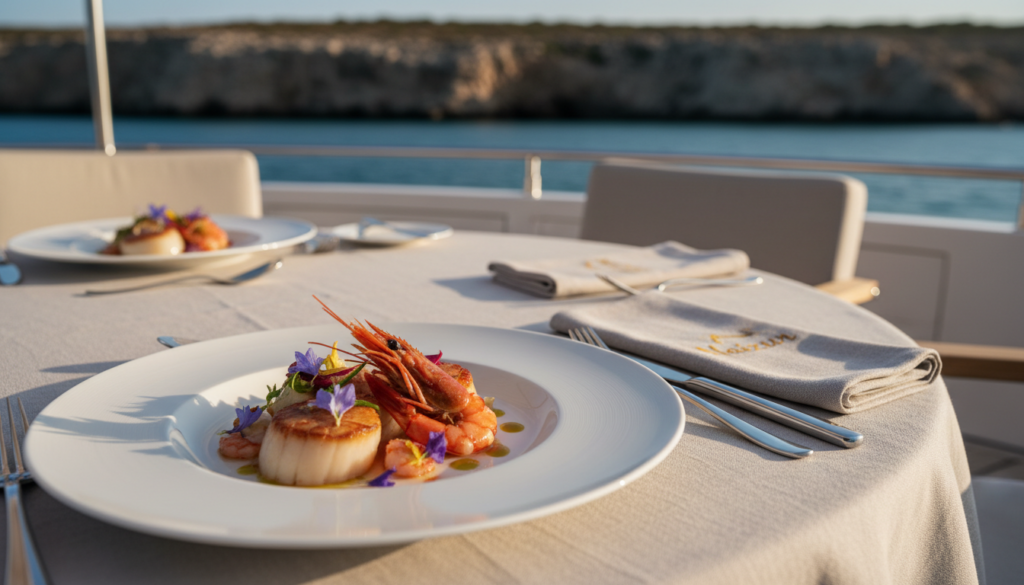
Included in the fee versus billed on top
This is the split that matters when you compare two quotes:
| Inside the base charter fee | Billed on top, usually via the APA |
|---|---|
| Exclusive use of the yacht | Food and drink provisioning |
| Professional crew and their wages | Fuel beyond standard daily cruising |
| Cabins, linens and toiletries | Marina fees and overnight berthing |
| Standard water toys and the tender | Port taxes and cruising permits |
| Safety equipment and marine insurance | Crew gratuity |
| Standard daily cruising fuel | Premium alcohol and dining ashore |
| VAT on the charter fee |
Two quotes with the same headline number can end up 40% apart once the second column is filled in. Before comparing anything, ask which pricing model each yacht uses. If you want the full picture on rates by yacht size and season, we cover what a week on board actually costs separately.
What a crewed charter adds on top
A crewed charter adds people and service to the base package. The yacht is the same asset; what changes is that someone else runs it, provisions it and cleans it while you use it.
The crew: captain, chef and on-board team
On a crewed charter the professional crew is always inside the base rate. At minimum that means a licensed captain and a chef. On larger yachts you will also have deckhands, stewards or a hostess.
The captain handles navigation, safety and route planning. The chef cooks to your preferences, dietary requirements included. Crew size scales with the yacht: a 15-metre motor yacht might carry a captain and a hostess, while a 30-metre vessel runs a full team of four to six. On a bareboat charter there is no crew at all, because you skipper the boat yourself.
Crew wages sit in the base fee, so you never pay them directly. Gratuity is the exception and it is discussed below.
Cabins, linens and living space
Your fee covers exclusive use of every cabin, bathroom, saloon and deck area for the whole trip. Cabins come with fresh linens, towels and basic toiletries, refreshed daily by the crew.
In the Mediterranean, most crewed yachts sleep between 8 and 12 guests across 4 to 6 cabins, each with an en-suite bathroom. Air conditioning is generally included, although on some yachts it runs on generator hours rather than continuously, which is worth confirming before you book an August charter.
Does a yacht charter include food?
It depends entirely on the pricing model, and this is the single most common misunderstanding. On a fully all-inclusive crewed charter, every meal prepared on board by the chef is included, along with soft drinks, coffee and tea. Premium spirits, wine beyond a house selection and dining ashore are extras.
On a plus-expenses charter, which is the standard format for larger motor yachts, food and drink are not in the base rate at all. You prepay the APA and the crew provisions the yacht to your specifications before you arrive. You still eat the same meals; you just pay for the groceries separately and see the receipts.
Water toys and the tender
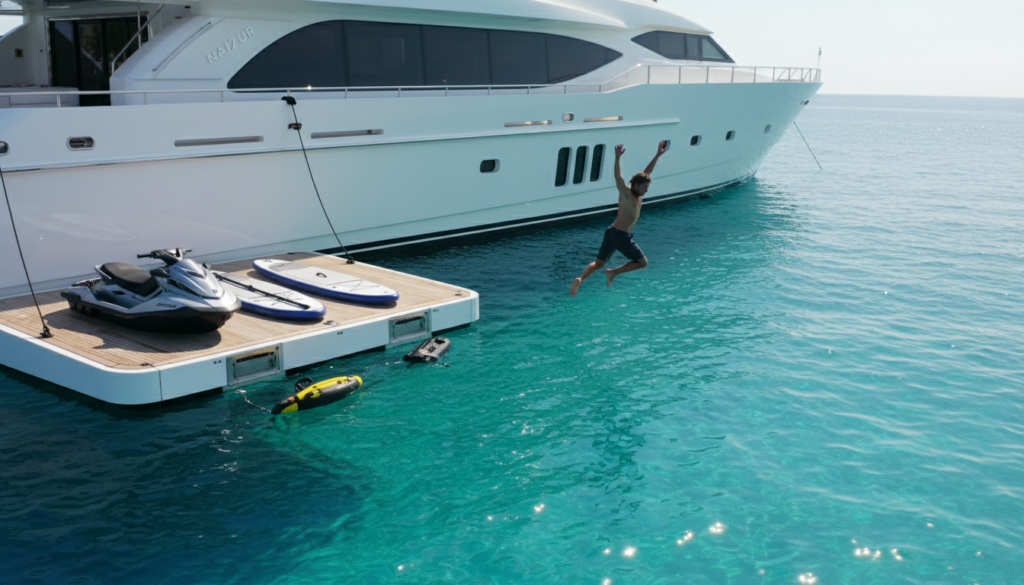
Most crewed yachts include a standard water toys package: paddleboards, snorkelling gear, kayaks and inflatable floats. Higher-spec yachts add wakeboards, seabobs and a larger tender. Jet skis and e-foils are usually optional extras with their own daily rate, and in Spanish waters they may also need their own licence and registration.
In practice the standard package is enough for a full day in any bay: snorkelling the posidonia meadows off Formentera, paddleboarding into a cove near Pollença, or using the tender to reach a beach with no road access. What is actually on each yacht is listed in its specifications before you book, and it is worth reading that list rather than assuming.
What is not included: the APA explained
The Advance Provisioning Allowance is a prepaid expense account, separate from the charter fee, that covers everything you consume during the trip. On motor yachts it typically runs at 30% to 35% of the base rate, and reaches 40% or more on high-consumption vessels or very active itineraries. Sailing yachts and catamarans sit lower, around 20% to 25%, because they burn less fuel.
A detail most guides skip: the MYBA charter agreement does not fix a percentage. Clause 8 defines how the APA works and leaves the figure blank for the broker to complete yacht by yacht. Anyone quoting you a universal APA rate is quoting fleet practice, not the contract.
The APA covers provisioning, fuel beyond the daily cruising allowance, marina fees, port taxes and shore transport arranged by the crew. The captain administers it, keeps the receipts and hands you an itemised account before you disembark. Anything unspent is refunded; if you overspend, you settle the difference at the end.
On standard daily cruising, fuel for three to four hours of navigation a day is already inside the base fee. That is enough to island-hop comfortably across the Balearics. Longer passages, one-way itineraries or sustained high-speed running are what push fuel onto the APA.
Tax, port fees and gratuity: the three costs people forget
Three line items sit outside both the charter fee and, in two cases, outside the APA as well.
VAT. When a charter starts from a Spanish port, Spanish VAT of 21% applies to the charter fee. Rates differ across the Mediterranean, so a Balearics quote and a Greek quote are not comparable on the base number alone. This is the cost most often missing from online charter calculators.
Port and mooring fees. Overnight berthing in a marina is charged against the APA, and in high season in Palma, Ibiza or Port de Sóller it can be a meaningful share of it. Anchoring out costs nothing, which is one reason a good captain will build an itinerary around bays rather than ports.
Crew gratuity. Not obligatory, and never inside the base fee. The customary range is 10% to 20% of the charter fee, paid at disembarkation and split among the crew. Crew salaries themselves come from the owner through the base rate, so the tip is genuinely discretionary rather than a wage top-up, but on a well-run charter it is expected.
Crewed, skippered or bareboat: what changes in each
The charter format changes the inclusions more than the yacht does. Three options, and the difference is who does the work:
| Bareboat | Skippered | Crewed | |
|---|---|---|---|
| Captain | You | Included | Included |
| Chef and service crew | No | No | Included |
| Provisioning | You arrange it | You arrange it | Crew, via APA |
| Licence required | Yes | No | No |
| Cleaning and turnaround | You | Shared | Crew |
| Typical cost | Lowest | Middle | Highest |
In the Balearics most first-time charterers book crewed or skippered. Bareboat requires proof of a valid nautical licence, and Spanish authorities enforce it: the skipper needs a PER, an ICC or an equivalent qualification, and the harbour authority checks the paperwork before the boat leaves. That single requirement rules out most visiting groups.
Why most charter yachts sleep 12 guests or fewer
Charter yachts cap overnight guests at 12 because of maritime law, not cabin space. Under the SOLAS convention, a vessel carrying more than 12 passengers, crew excluded, stops being classified as a yacht and becomes a passenger ship, which triggers a far stricter and more expensive regime covering construction, lifesaving equipment, crew qualifications and inspections.
The threshold dates back to the first SOLAS convention of 1914, adopted after the Titanic, and the version in force today is SOLAS 1974. For 13 to 36 passengers, the REG Yacht Code Part B applies, which replaced the Passenger Yacht Code in 2017. Very few charter yachts are certified to it, because refitting to that standard rarely pays for itself.
This is why a 30-metre yacht with room for twenty people at lunch still sleeps twelve. Day charters are different: some vessels are licensed for more day guests than overnight guests, so if you have a larger group for a single day, ask specifically about the day licence rather than the cabin count.
What a charter day in Mallorca actually looks like
To make the inclusions concrete: a crewed day charter out of Palma starts with the boat fuelled, provisioned and ready when you arrive at the marina. You board, the captain runs the safety briefing and the planned route, and you leave. Breakfast or snacks are served under way.
The first anchorage is usually a bay on the southwest coast, where you swim, snorkel with gear from the yacht and use the paddleboards. Lunch is cooked on board with ingredients sourced that morning. The afternoon repeats the rhythm: another bay, more time in the water, then back at sunset.
You step off having decided nothing except where to go next. That logistics-free day is what the charter fee is actually buying, and it is the part no line item on a quote describes.
Ready to see what is available in Mallorca?
Naizur operates more than 40 motor yachts in the Balearics, from 8 to 37 metres, with day charters from Palma starting at 480€ per day. We are also the exclusive Kumbra dealer in the islands, so a good part of the fleet is boats we know down to the engine hours.
Every quote we send separates the base fee, the APA estimate and the VAT, so you can see the three numbers before you commit rather than after. Browse our Mallorca fleet and day rates and tell us what your group needs.